Demolition Notice

Poem by Zoe Younessian

of saccharine rituals / of orange-netted gifts / of the kitchen that smelled of mulberries whenever it didn’t rain / of your ringless fingers circling mine / before men who reeked like the sea / hazy afternoons meant everything / peach slices in a ziploc bag / juice staining wrists / the outline of your smile morphing into marbled countertops / before salt & hurried marriages / you were always concerned with preservation / once said / mold grows when you mix sweetness with water / mold knows to steal anything with weight / like food / like distance / everything gone / remember when ma scolded us for mourning fallen houses / devoured by underbrush before the city / could steal their skeletons / i see none of you anymore / but your basket of peaches / rotten in the faltering lamplight / ma’s lingering words / what is demolished must have never been missed / yet absence has a weight / yet i called for your shadow’s demolition / still the mold grows / and grows / and grows 

Remember When?

Poem by alarminglytired

Do you remember when I first realized you were growing up?
I don’t think you do, because I never told you.
But I was crestfallen.
There I was standing in the aftermath
of you packing up our childhood in a suitcase,
bursting at the seams with all the giggles
and innocence we once cherished,
as if you were so eager
to leave me behind,
to zip it up and walk away.
Each thread of you,
a memory woven tight.
A ghost haunting the air between us,
whispering secrets only I could hear,
secrets that unraveled my heart
with every breath I took.

Do you remember when we slowly
stopped talking to each other?
It was terrifying,
watching you shed bits of yourself,
discarded like yesterday’s news.
Like crumpled pages of a story
I thought we were still writing.
The ink barely dry,
as if you believed
the future holds no room
for the little pieces
that once made you you.
The echoes of our pretend plays,
the warmth of innocent dreams,
crushed beneath the weight
of a new world you’ve gone chasing.
A world that feels foreign,
as if it were designed
to erase everything we built
with our hands and hearts.

And oh, do you remember how much you thrive
without those fragments—
the ones I cradle,
the ones I revisit
like old love letters
written in your laughter,
that escaped from the lips that told
me, “I’ll never leave you behind,”
when I voiced these fears of you growing up.
Do you remember when I told you that?
Yet here I stand, alone.
Each word a whisper of who you were,
before you slipped
into someone new,
an evolving shadow,
a flicker of light
dimming just out of reach,
leaving me standing in this twilight,
clinging to the fading glow,
my fingers tracing memories
that slip away like sand,
each grain a reminder
of the child who once danced
in the sunlight of my embrace.

And do you remember when you asked me
why I am still tracing the outlines of your absence?
Why do I still wrap my arms
around the lost parts of you?
Why do I hold them close,
so close my bones break,
splintered beneath the pressure
of your absence,
the struggle to breathe
in the emptiness
you’ve left behind—
an abyss where memories linger,
a haunting refrain
of “Remember when?”
that echoes louder
with every step you take away,
each footfall a distant drum,
thundering in my chest
like the wretched tolling of a bell
that rings only for the lost.

Do you remember the time
when you finally saw me again?
Just for you to talk about how great
you’re doing without me.
How your world keeps turning,
while I’m still learning,
reeling from the way you carry on
with me gone.
Remember when you had to ask me if I was happy for you?
And without missing a beat, I replied “I always am.”
You were my mirror,
a visage of a person I aspire to be.
Now I gaze into silence.
Because I didn’t know,
I didn’t know
I was holding my breath,
my heart in a fragile cage,
until you took your first step away,
and I gasped, grasping at the air,
realizing your absence is a vast space,
a chasm where your ghost might sit,
just out of reach,
filling the silence with everything
we used to be.

Remember when you left me to
stumble through our memories?

The moments that flicker
like dying stars,
each one a reminder
of our constellations,
lost in the dark,
the black canvas of my longing
stretching infinitely,
with no hope of return.
So here I stand,
in this empty room,
screaming the echoes of what once
was, my love, my loss,
waiting for your shadows
to return and teach me
how to breathe again,
to remember the rhythm
of our heartbeats intertwined, to
feel the weight of your laughter
like the cherished blanket
we used to make play forts,

woven from the threads
of who we were,
a tapestry unraveling
with each passing moment, so I
might gather the fragments of
this shattered dream,
and in the quiet,
find a way to let go,
while still holding on,
to the bittersweet taste
of everything
that made us whole,
the remnants of a smile
that made forever feel like a
ghost I can never quite catch,
always just beyond my reach,
forever haunting my waking
hours, filling my nights with a
sorrow that blooms like a withered
flower, its petals falling,
one by one,
until you remember when.

She

Poem by Vanshika Srivastava

They say it’s damn hope
alive and alight
like that twinkle that spins on the
chandelier, like the one in a child’s eyes.

Then there are those
too eager to wallow in spite
twisting and turning the knits
of sheer joy,
What once was called being a child.

When a candle burns too much, too close
Comfort is found in blowing it out
And little do they know,
It’s the fever of what was once a dream
now the ghost of how youthful one was.

We lie and lie and lie
We hold our truth in our apathy
And now the mirror always shatters in her eyes
Bespoke are the words,
A secret, sworn to be taken to her grave
Laced under the shadows of what was and has been.
Who?
To whom was the endearment of “she?”
bestowed? She was there for enough for all
and nothing but a grand fall.

She Told Me the Meaning of Love

Memoir by alarminglytired

Love, as the dictionaries and movies would have you believe, often bursts forth in vivid colors—grand gestures and epic romances that leave an imprint on the heart. It’s the soft brush of lips, the quickening heartbeat, and those fireworks that make you forget where you parked your car. For years, my understanding of love was painted with the broad strokes of scripted lines from romantic comedies, ones I thought I could recite without missing a beat. But everything changed when I met her in junior high.

From the moment I laid eyes on her, I was drawn to her like a moth to a flame. Our conversations flowed effortlessly, jumping from our favorite gacha life songs to whimsical dreams of owning a cozy house together one day. Those seven years transformed her from a mere friend into my confidante, my partner in crime—the one who challenged me, nudged me toward growth. “Love,” as I would come to know it, blossomed in the laughter we shared, the way her quick wit and artistic air brought light into my life. One moment, she had me rolling on the floor with laughter, and the next, we were deep in discussion about how this character stole the spotlight in her favorite series.

In her presence, I discovered a truth that transcended the conventional notions of love. It isn’t merely about romantic entanglements or dramatic declarations. Love is the unwavering support of someone who sees you at your worst and still believes in the best within you. So when someone asked me, “What is love?”, I found myself answering her name without hesitation. When a stranger
remarked on the way I looked at her, claiming it was as if she were a star in the sky, I chuckled quietly. The truth was far deeper—I looked at her as if the universe itself began and ended with her.

Love is the girl I met seven years ago in junior high school. Love is my friend, Jasmine.

From the perspective of my childhood best friend’s home 

Poetry by Hailey Jiang

Your hair is brushed and let loose now, 
No longer in the messy ponytail 
You refused to leave the house without. 
Your braces are off, the metal 
No longer stinging your lip. 
I don’t recognize you, yet 
I know every inch of you. 

Your fingers twirl your hair, 
You’re nervous, looking at me. 
Your fingers twirled your hair 
In the same pattern as 
You waited for your parents’ answer 
To the sleepover you constantly begged for. 

Your knee still bears the scar 
From when you tripped 
On the walkway that was your runway. 
You avoided the cracks in the rocks after that. 
The walkway has since been changed, 
The rocks smooth and shiny. 

You sit on the sidewalk, 
Extend your right leg in front of you 
The same way you did at nine years old 
Next to her, your foot resting 
In the cracks of the stairs. 

Your hands pitch pebbles into the empty street 
The way you threw darts 
At the bullseye target in the garage. 
The ivy growing on the stone 
Has now covered the 
Chips in the wall from the 
Missed shots, only visible to 
You and I. 

Your eyes scan the dark upstairs window
In the same pattern you did at dusk,
Looking for the light of her pink lamp, Hoping to catch her eye 
For one last goodbye before 
You left. 

You climbed into your parents’ car, 
Hating how overprotective they were,
How you couldn’t go anywhere alone. 
Yet today you turn around and walk home,
Old enough for freedom, but not
Old enough to forget who I am.

You Are a Hangover

Poem by Hailey Jiang
C.W: Allusions to Alcoho
l

First shot. 
I swallowed it quick. 
A knot in my stomach, 
Your eyes lost in mine. 

Second shot. 
I could get used to this. 
The room spun and the lights coalesced. 
Sweat dripped off my temple 
Your lips on mine. 

Third shot. Fourth shot. Fifth shot. 
I drank you up 
Shot after shot, kiss after kiss, 
The faint moonlight illuminating the flush on your cheeks. 

I was enchanted, 
wasted, our potential was 
just out of my reach. 
I couldn’t see clearly, couldn’t walk 
in a straight line 
into your open arms. 

I couldn’t react, couldn’t 
Stop your vomit
 Staining my shirt, no matter 
How hard I scrubbed. 
You were there, a constant memento. 
I tripped, my final chance to 
fall into your arms, but you 
Dropped me. 

Your speech slurred, 
Said this isn’t it instead of I love you
Get off me instead of you are my everything. 

Your lips left a mark I can’t 
Get rid of, no matter how much
Chapstick I apply or how much water I drink. 

Your eyes too bright, 
My head aches, too loud, 
My temples throb. 

My memory is blurred, 
I don’t know what happened after. 
All I know is you are gone. 

And I can’t get rid of this damn hangover.

Beatrix Potter’s Legacy: Ways to Support our Wildlife 

Research Paper by Gabrielle Wilkinson

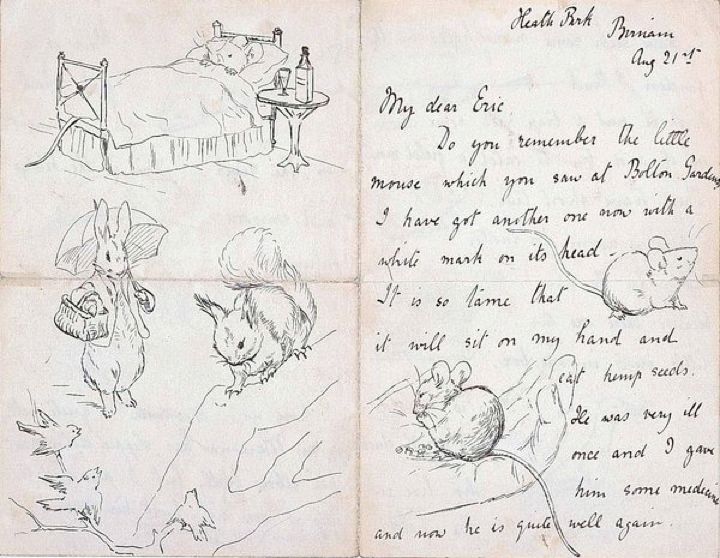
Beatrix Potter was an adored author and conservationist, best known for her children’s books centered around animals, most famously Peter Rabbit. Leaving her home to the National Trust, Potter wished for a legacy of preservation, specifically of our beautiful countryside and all the small creatures that call it home. 
As we face a wildlife crisis, we can use the legacy of Beatrix Potter and the enchanting world she created to protect the characters she loved. 

Mrs Tiggy Winkle 

 Beatrix Potter, Public domain, via Wikimedia Commons

As a self-proclaimed Mrs Tiggy Winkle enthusiast, she earns her place at the top of the list. The inspiration for Mrs Tiggy Winkle came from Beatrix Potter’s own hedgehog, also named Mrs Tiggy Winkle! Her kind nature and cute black nose has weaved her into the hearts of millions. 
Hedgehogs are now listed as ‘near threatened’ on the International Union for Conservation of Nature’s Red List. Their decline is due to factors such as urban development, pesticides and traffic. 

How to help our prickly friends: 

  • An important one; be careful on the road at night! As hedgehogs are nocturnal creatures, they are typically out and about at night. If you see a prickly ball on the ground, it may be a hedgehog in their defensive state. 
  • Make a hedgehog home! A fun activity to do with the family that will give our prickly friends a place to rest their head! 
  • Leave a leaf pile: An excuse to not keep the garden tidy! A leaf pile provides the perfect environment for worms and other insects, a delicious snack for hedgehogs.  

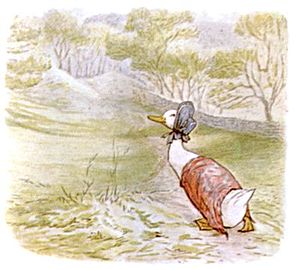
Jemima Puddle Duck 

 Beatrix Potter, Public domain, via Wikimedia Commons

Jemima Puddle Duck is beloved across the Beatrix Potter universe. Her gentle nature and grit has made her one of the most well known ducks in literature, fighting off competition from Donald Duck and the Ugly Duckling. 

The Bread Phenomenon 
Many of us will have childhood memories of going to the local park to feed the ducks leftover bread. However, recently you may have seen signs discouraging you from this, and for a good reason. 
Bread offers little to no nutrition for ducks. In fact, it creates water pollution from the bacteria inside. It can also cause malnourishment by tricking ducks into thinking they are full when they are not! 
The Canal and River Trust has put together a list of what to feed ducks instead next time you are at the park: 

  1.  Sweetcorn: Ducks actually love this sweet snack! 
  2.  As a nation, we are guilty of throwing away vast amounts of lettuce so next time you go to the bin with leftover lettuce, why not rip it into pieces and take it to your local park on your next walk! 
  3.  Seeds: a nutritious snack for our webbed friends! 
  4. REMEMBER: Ducks cannot chew food, so make sure it  is in tiny portions so ducks can enjoy these snacks without an issue! 1

Peter Rabbit 

THE TALE OF JEMIMA PUDDLE-DUCK BY BEATRIX POTTER. WikiSource

I can’t write a piece about Beatrix Potter characters and not talk about little Peter Rabbit. The mischievous little bunny loves to cause trouble in Mr McGregor’s garden – in fact, the 6 books featuring him have sold over 150 million copies!  2

Urban development has introduced rabbits to new predators including cats and dogs. Data from the Smithsonian Migratory Bird Centre suggests that domestic cats alone are responsible for the death of around 2.4 billion birds and 12.3 billion mammals annually, many of which are wild rabbits. Whilst wild rabbits can be mischievous like Peter Rabbit and steal a carrot or two, they are vital in maintaining healthy ecosystems and are crucial in the food web, influencing plant life by fertilising soil. Their little burrows provide shelter for smaller creatures like mice and ground birds, earning them a hero status, just  like Peter Rabbit! 
Here are some tips on how to help our long eared pals from the Environmental Literacy Council: 

  • Create a pile of branches and twigs: this gives refuge from predators like hawks. 
  • Avoid clearing vegetation during nesting seasons in spring and summer.
  •  Curb your curiosity during nesting season and do not pry with nests! 3

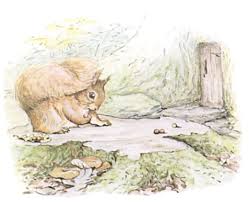
Squirrel Nutkin 

The Project Gutenberg eBook of The Tale of Squirrel Nutkin

Another naughty character is Squirrel Nutkin, known for his unmannerly and rude nature with his impudence to Old Brown Owl getting him into serious trouble.. 

Red Squirrels are classed as Near Threatened in England, Wales and Northern Ireland. The main reason for their decline was the introduction of grey squirrels from America. Grey squirrels carry a disease known as Parapoxvirus that kills red squirrels.They also leave little to no food for their red counterpart, typically eating grey acorns before they ripen. We can do our bit by feeding these charming red critters; here are some things to remember about feeding our red bushy tailed friends: 

  • – The best foods for red squirrels include sunflower seeds, apples, carrots and walnuts. 
  • – Do not attract them to your garden if you are next to a busy road as this puts them in danger. 
  • – Before feeding, make sure there are no grey squirrels in the vicinity as red squirrels can be exposed to Squirrel Pox.

  1. What do ducks eat? | Six healthy options. (n.d.). 
    ↩︎
  2. Beatrix Potter, Public domain, via Wikimedia Commons
    ↩︎
  3. Team, E. (2025, February 26). How can we protect wild rabbits? The Environmental Literacy Council. https://enviroliteracy.org/how-can-we-protect-wild-rabbits 
    ↩︎

Press Release

Clarity in Uncertain Times

Where We Stand as a Canadian and International Magazine

Edmonton, April 14, 2025: In light of the ongoing social and political challenges in the world, SeaGlass Literary reaffirms its core values and unwavering commitment to justice, inclusion, and human rights. As a platform dedicated to amplifying diverse voices and fostering meaningful dialogue, we believe literature is inherently political, and we stand firm in our responsibility to advocate for positive change.

We are proudly Canadian-born and owned and hold steadfast to our values.

We stand for equity, inclusion, and dignity for all people. We affirm the right to love and exist freely, regardless of sexual orientation, gender identity, race, or ethnicity. We believe in a world that is accessible for all. We advocate for bodily autonomy and gender equality. We uplift marginalized voices and reject all forms of discrimination. We actively promote diverse perspectives in literature. We support religious freedom, self-determination, and humanitarian causes. 

Our hearts go out to those in Palestine, Ukraine, and the rest of the world who are suffering in unjust conditions due to the egregious actions of oppressing nations. We recognize migration as a human right and believe that people cannot be illegal. We are against all forms of genocide and neo-nazism. We believe violence is never the answer and should never be used by a government for fear mongering.

We support facts, research, and public health initiatives. We believe in the power of knowledge and books and support everyone’s freedom to learn and read. 

We support the separation of church and state and religious freedom; belief and non-belief should never be weaponized against others. Empathy and ethics are at the core of what we do and hope to spread compassion and humanity throughout the world. Finally, we believe in the sovereignty of nations, which includes Canada, Greenland, Palestine, and the Ukraine as they are not for sale or taking.

We believe that writing is inherently political, and for many of our volunteers, authors, and readers, their very existence has become politicized. We refuse to be silent or neutral in times of injustice. Our commitment to advocacy, unity, and truth will never waver.

SeaGlass Literary will never be pressured into sacrificing the morals and ethics we have upheld since day one. We remain a space for open discourse, community building, and transformative storytelling—because literature is not just about escapism; it is a force for awareness, empathy, and action.

For more information, interviews, or inquiries, please contact: Makayla Anderson at pr@seaglasslit.org

This message has been approved by the board of SeaGlass Literary for public distribution. No contents of this letter may be changed or altered in nature. To view the full and original document, please use the button below.

Peace

Poem by Vanshika Srivastava

Sorry, my kin, 
My pocket is full of dimes 
Your bag of felicity had a stitch loose 
Since the very first time. 

The ray of hope can be blinding, 
And now the knock is heard at my door 
My hands tied behind, my plea refused 
That my pocket is just full of dimes 

And the hand that holds the gold 
is the hand that surfaces through 
amidst the crowd of the do’s and don’ts. 
With glee they measure their generosity 
With ease they gleam with their papercut smiles 

And henceforth I ran as far as I could, 
For as long as the hours prolonged, 
The sunset up by the bay 
Seemingly tarnished me with its golden ray 
And slowly I simmer down to a hasty stop. 
With a new thumping start, peace wrapped around me 
Like an old friend’s arms, 
Like the cup of coffee I have everyday 
yet still yearn for.

Old Habits Die Screaming

Memoir by alarminglytired 
CW: mentions of self-harm

I was twelve when the sterile shine of bathroom tiles became my reluctant canvas. I would crouch there, scrubbing furiously, the bristles of the brush scraping against the tiles as if I could erase the evidence of my internal struggles. Each stroke was a desperate attempt to cleanse not just the floor, but my soul—a futile effort to wash away the whispers of pain that echoed louder than any confession I could muster. 

“I have to make it spotless,” I would mumble to myself, my voice barely rising above the sound of running water. “If it’s clean, maybe I can pretend everything is okay.” I could hear my mother’s soft footsteps in the hall, oblivious to the tempest that brewed within me. It was easier to hide, to craft a façade of normalcy than to let anyone in. 

By thirteen, I became a master of deception, cloaking my scars under layers of feigned laughter and bright smiles. “Look at me!” I would shout, a little too loudly during lunch with my friends, their giggles like bubbles rising in the air, masking the heaviness in my chest. Inside, I felt like a marionette, strings pulled taut by secrets. I learned how to laugh without joy, how to nod at conversations while my mind drifted into darker territories, the shadows creeping ever closer. 

One afternoon, while flicking through channels, I caught a glimpse of my reflection in the TV screen—eyes that seemed too old for my thirteen years, the corners of my mouth pulling upward when I wanted to cry. “What’s wrong with you?” I whispered, the question lingering like smoke in the air. It was a reminder that I was losing the battle, but even so, I hid it behind a mask of youthful exuberance. 

Seventeen arrived with an undeniable weight, a heavy stone dropped into the pit of my stomach. I stood at the edge of my own existence, watching as those old habits slithered back, like shadows stalking me through the dimly lit hallways of my mind. “You think you’re free?” they seemed to taunt, whispering sweet nothings that felt all too familiar. I’d glance at my reflection in the mirror, the pale lines etched into my skin whispering tales of battles fought in silence. “You’re not broken; you’re just… healing,” I would repeat, though sometimes, I didn’t believe it. 

Four years later, and the yearning flickered within me once again, like a candle’s flame flickering in a gust of wind. “You’re still alive,” I reminded myself as I traced the scars with trembling fingers, imagining reopening them, the rush of crimson staining my skin, a vivid splash against the monochrome of my existence. “But at what cost?” I questioned, feeling that old dread coil around my stomach, as if reminding me of the fear in strangers’ eyes when they glimpsed the truth beneath my skin. 

“Just hold on,” I whispered to myself, the words barely escaping my lips as I stood there, caught between the past and the present. The pull of the blade was strong, an old friend hidden among forgotten books, gleaming with a pristine promise. “You know what relief feels like,” it seemed to say, seducing me with the illusion of escape. I could see it, beautiful and terrible, glinting like a siren’s call. 

But at that moment, I knew what I had to do. “No,” I said firmly, shaking my head as if to dispel the dark thoughts. I walked towards the bathroom, every step heavy with resolve, my heart pounding in my chest. 

With a swift motion, I threw it away, severing the thread that bound me to that dark past. A small victory, perhaps, but a powerful one. “Sometimes, the most genuine act of rebellion is choosing to be whole,” I reminded myself, feeling the weight begin to lift. Here, in this moment, I was not broken; I was healing. I stood before the mirror, and for the first time in a long while, I dared to smile, the reflection staring back at me filled with hope—a fragile but real thing. I am not broken, I am healing.