Come, What May

Written by Haiqa Mariam

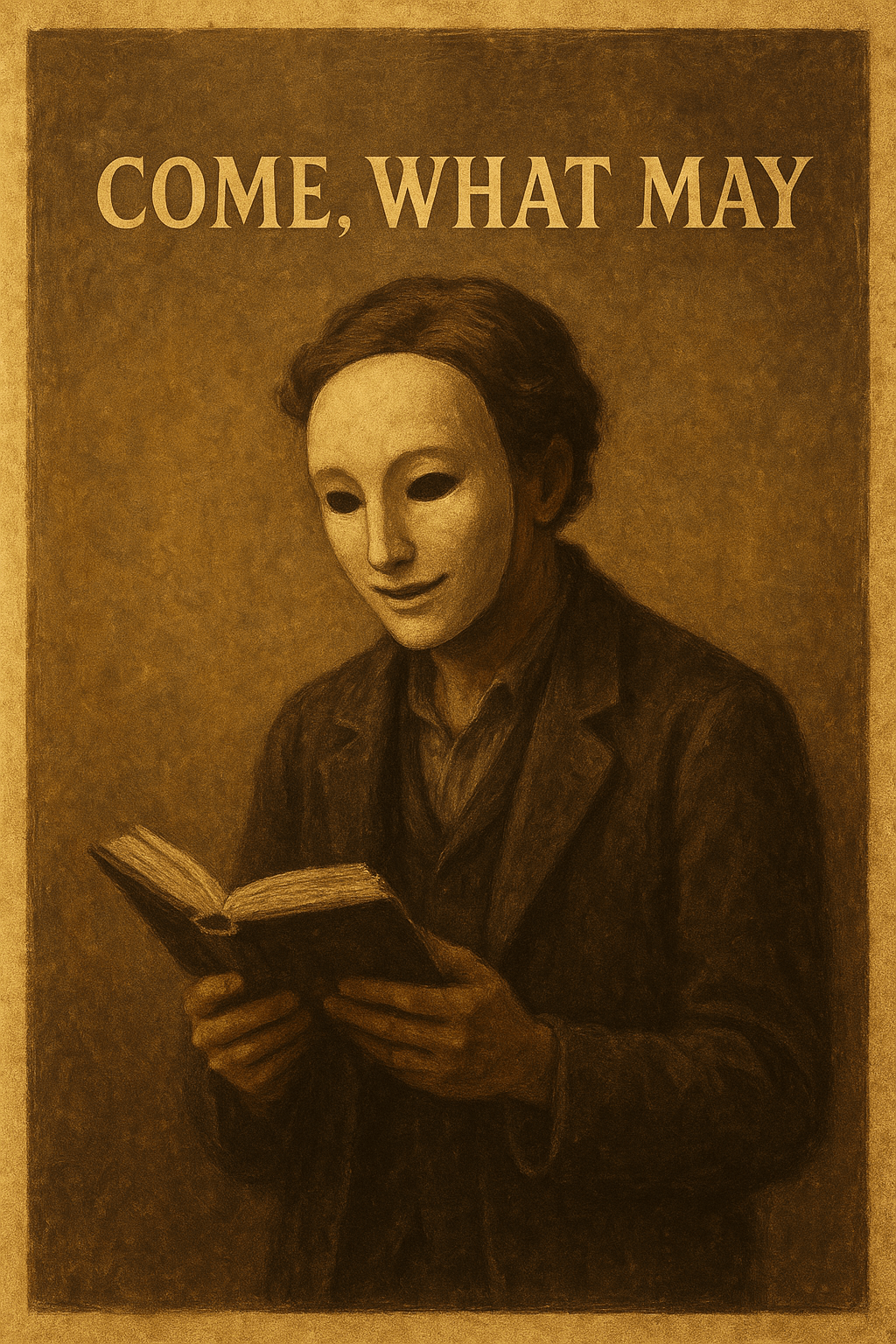
The lives we play behind the mask:

who knows what secrets we conceal,

what answers we offer to those who ask,

where we abandoned our pride, unreal.

It is ironic: they see only what we show,

turning the world into a vast stage.

Behind bright smiles, strangers grow,

like characters upon an unread page.

The ones who shine with radiant light

are often consumed by untamed pain;

the children whose eyes once gleamed so bright

now bear a heart imprinted with stain.

How long can we sustain a heart of stone?

How long can we blame others when the foe is our own?

How long must we battle this rage unknown?

How long persist in this endless low?

Yet even when the heart seems near its end,

another page turns, another chapter begins.

What it holds—calamity or contentment—

only the Lord knows what fate intends.

Still, with hardship comes a promised ease,

and where faith endures, triumph is near.

So what is austerity, when at last we seize

a victory etched beyond all fear?

in the perspective of a plant who sees its owner as its mother;

Written by alarminglytired

T.W.: Mentions/Allegory to sexual assault (only the aftermath)
I stand anchored in this space, my leaves stretching toward her warmth, my mother. She waters me daily, yet every droplet carries the weight of her bitterness, of a choice that she was forced to make. I taste the sharp bite of antiseptic on her fingers, the cold, sterile light that hums overhead; too bright for my leaves. She hums softly to me, but beneath those gentle notes, I detect the muted sorrow that seeps from her very soul, a pain that echoes through my roots. Each lullaby, meant to nurture, feels like a piercing wound to my tender form. I am meant to thrive in her care, and yet I am starving. 

I don’t blame her in the slightest, though. She wanted to be a doctor. She wanted to help people and be their beacon of hope in these dark times. But other people are greedy. Other people are selfish. They left her to throw away the articles of fabric she was wearing, to scrub her skin multiple times to try to purify her transgressed world. But it remains. She knows it is still there, for I exist. 

Since then, I learned to twist and bend to her unspoken will, even as I feel the shadow of decay that encircles her. It clings to my fading leaves, binding us together in an unbreakable bond of suffering. As I sense the energy ebbing from my core, I feel her embrace me. Those hands, familiar only with anguish and tainted by despair, cradle me, as gently as she can. Her hands shake uncontrollably, and her breath quickens, but she holds me. I wish she knew I did not blame her in the slightest for reacting this way. It is not me she detests, not me she wishes desperately to rid all trace of. I wish she knew that I did not blame her in the slightest. I wish she knew that. It was in that moment, for the first time as a plant, that I wished to be human. Because it is here, amidst our shared pain, that I long to smile.

Bring Me Home

Written by Gi Buelow

When I die, 
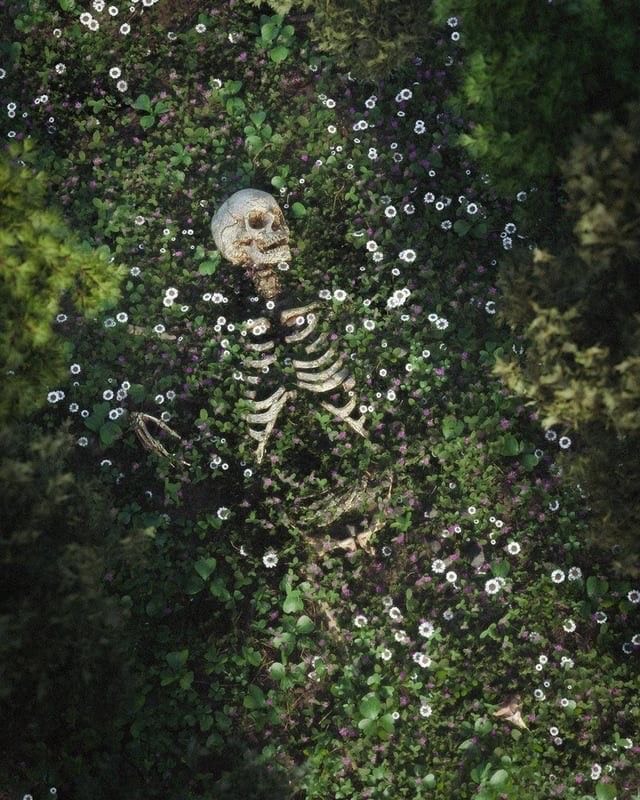
I want to be returned to the Earth. 

But I don’t mean some stuffy, wooden coffin
that’s meant to last forever. 
No, 
I want a coffin that will rot along with me. 
I want it to degrade alongside my body, 
and in our mutual deaths 
I want flowers to bloom and grass to grow. 
I want to be my own little garden. 
I want to be a memory in a fruit tree. 

I want mother nature to hold me, 
caress me 
like she has my entire life. 
I want to be one with her.

I want her to protect me like I have tried to protect her—
even if I have failed—
because my earth is dying. 

Let me go with it. 

I want the dirt to be perpetually stuck in my bones, 
like it was my fingernails. 
The only way to get it out, to carve 
straight to the end of the white 
until there’s nothing left. 

Don’t put me in a place that will keep the butterflies 
from landing on my blooms 
like they’ve landed on my shoulders. 
Don’t put me in a place where birds 
can’t swoop down and pull worms out of my dirt 
like I did when I was younger.

Let my flowers fade in winter, 
just to grow back in spring. 
For even in death, 
I shall inevitably be a terrifying cycle 
of devastating endings, 
and beautiful beginnings.

Because the earth is my home, 
and when I die, 
I want her to be returned to me.

Rain-from an Unconventional Solitude

Written by Subhashree Pattnaik

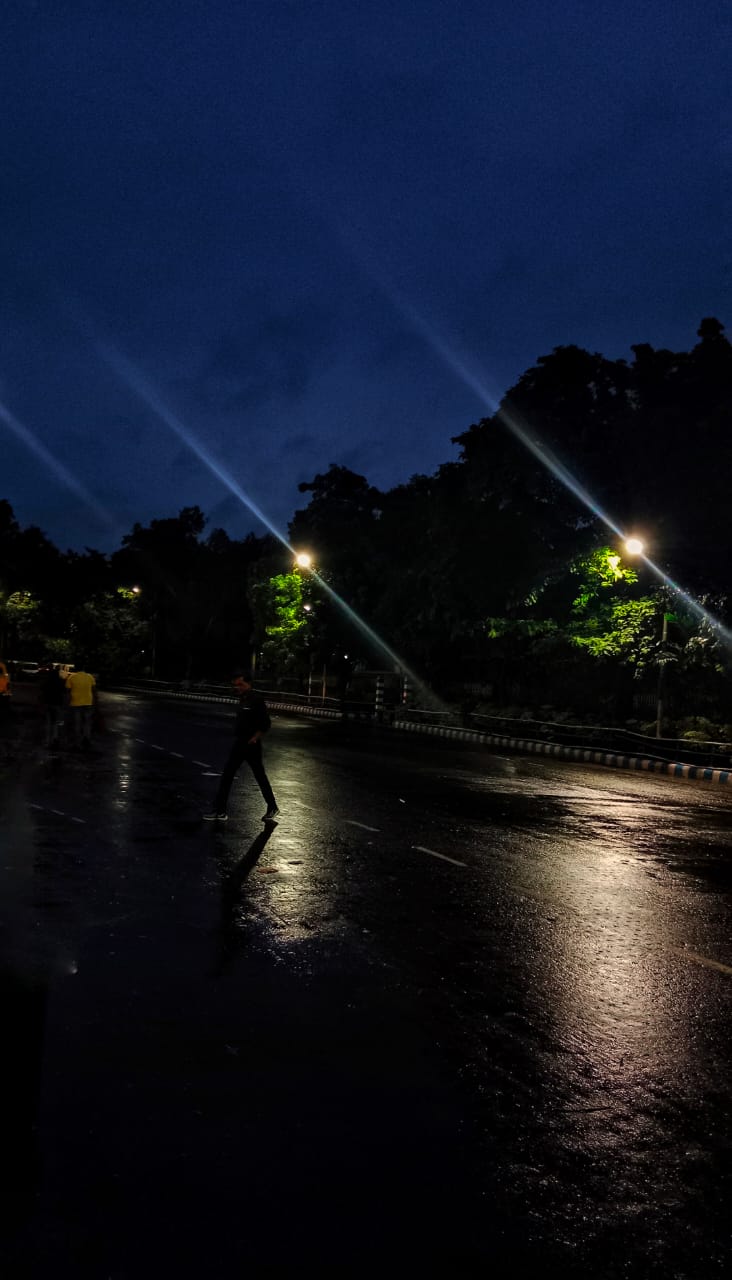
It’s late at night and sleep doesn’t seem to be hovering around in my room. But rain sure has replaced sleep. The sound is too tempting to not indulge in solitude and sit in a corner, where I can see the drizzling waters in orange light and hear it quenching the land’s thirst. It’s not romantic to watch rain from a distance. It’s not something intrinsic either that moves whatever could be moved inside me. It’s just a stillness and a monotonous solitude that becomes an action of self-reflection. 

There is almost no one in the road except for the trees standing at the sides. It’s not a lonely sight nor does it haunt me. It is in fact something terribly real. Why? There is such a space inside me perhaps. Can I stand there? No. Do I wish to? Maybe. It’s universal. I am not lonely now, but I once was. Reality keeps fluctuating like that. I wish to make coffee and have it in the rain. But I can’t. Because one way or the other, I do need to sleep. The next day won’t be as still as this night. 

A solitary rain spectator as I am now— I think of things and times passed. The space outside looks like a void in which I feel consumed. Despite being away from the drops,  in shelter I can very well feel what it’s like to be under the blurred streetlights. What I’m going through is not really remembrance nor sweet nostalgia of days passed. But, a recollection of things that tend to leave me incomplete still, the collective accounts of what could have been and what could be. 

I think of the times I could have been kinder. What could it have cost me? What could it have made of me then? And all the times I wasted my kindness like flowers plucked for momentary pleasure. Why? My kindness wasn’t meant to be butchered like that. Butchered. Too intense a word for an abstract like kindness. I have always been this intense for everything around me. My anger, my sadness and the casual fits of annoyance. How? Whatever had made me angry doesn’t seem much of a deal now. My sadness seems to have settled inside me like dust in a closed store. I do get annoyed but perhaps that too will become a future observation or self-reflection. 

It’s not a gesture of guilt, nor regret. So, then why must one always revisit what could have been? Is it a consolation to who you are presently? Or a comparison? Am I different from who I used to be? And does it even matter now— who I used to be? Perhaps it does— to the void inside me. The void inside me that I can see outside from my solitary corner.

What We’ll Remember

Written by Zoe Younessian

you can’t remember the last time 
you saw something ugly, 
only lime-colored turf with plastic pointing
the right ways. you saw elms in a row with
the bark painted on. you watered fake plants
and missed the real ones: daffodils erupting
like daggers, the roughness of a cat’s tongue.
you scolded the sky for the prettiness of
sunsets. pollution a thousand floating dahlias.
the forecast responded, that’s just the way
things are. you know everything burns more
beautiful.

Meditations on Taylor Swift

Written by Kevin Jin

As we continue along the winding road of writing mastery, we must be mindful that the enemy is often far closer than we think. The eager novice (myself included) tends to gorge themselves on the buffet of writing advice and opinions available online, swallowing craft books, party-packs of anecdotes, maxim canapés, and junk food platitudes alike. This, like any exercise in gluttony, accumulates fatigue. The change is slow, but by the end the budding writer is tiptoeing around an abundance of red tape just to produce a single sentence. They measure every word, paragraph, and story against so many different guidelines that their story is barely perceptible beneath the noise, confusing technical proficiency for quality of fiction and mistaking the trees for the forest. I only recently put my pack down and realised how much of this baggage I had accumulated, and it was all thanks to Taylor Swift. Not the singer though—rather Hugh Behm-Steinberg’s contest-winning flash fiction piece of the same name. “Taylor Swift” was Remy’s ratatouille to my Anton Ego. Judge Steve Almond of the 2015 Barthelme award put it best when reflecting upon his selection of the story: 

“Full disclosure: I tried quite hard to resist choosing ‘Taylor Swift’… Why? Because all the stories I received were worthy and many were more technically ambitious when it came to language and form, …because I feared selecting a story entitled ‘Taylor Swift’ might speak to my literary deficiencies, or plain old drooling idiocy. But what the hell. In the end, I just wanted to read this thing again and again.” 

 That last line, obvious though it may be, touches on a simple truth about writing that is too easily forgotten. Good writing is subjective, but good fiction is reliant on one thing: the story experience. Somewhere amidst the ocean of exercises to pare sentences to the bone and compose witty wordplays, our idea of good writing morphed into a qualitative assessment. Good fiction “should” be deep and verbose, experiment with form, and say something about the human condition. It “should” revolutionise your life and leave a mark on the cultural consciousness. Almond’s conundrum is a symptom of this: technically ambitious writing feels like it ought to be “better”, but as “Taylor Swift” shows, your writing just needs to be fun and have spirit.

Almond mentions this when he talks about the story’s heart and love: “It extradites us to a realm of strange wonders and incantatory rhythms in which we are forced to acknowledge that the heart and its deranged pursuit of love cannot be disabled or even diminished by our neurotic defenses.” And boy, is he right about the neurotic defences. Ever the critic, I too had a knee-jerk reaction against the title, ready with all manner of sarcastic comments and weaponised feedback to tear the story apart, but I too was won over by the simple, funny, and above all, pure story that I had read.

“Taylor Swift” is a ridiculous premise, drenched in humor, and packaged neatly at 500 words on the dot, yet it is far more than the sum of its parts. It’s a pure fiction story in the sense that it doesn’t try to do anything but make you laugh and transport you to a fantastical world where Taylor Swift can be bought by the dozen. By nature of being a flash piece, it’s definitely been combed over meticulously and trimmed of unnecessary words like the many adages say to do, but the key thing is that at no point does the voice feel curated.

The story starts sentences with conjunctions, skips them altogether sometimes, and does away with quotation marks entirely, but these transgressions don’t matter at all. The wisdom imparted by the Elements of Style, On Writing, and other books on the craft have their place among the chorus of voices that can refine yours, but when you approach them as gospel your writing loses its earnestness. The output is homogenous in the same way ChatGPT can write a perfect, technically sound story, but it will never be able to move people in the way that a child’s scrawl can. Behm-Steinberg’s desire to take the readers of “Taylor Swift” on a journey is so dominant that even if the words are tinkered with, the story’s voice remains uniquely entertaining and its own. With its laid-back prose, the pocket-sized piece effortlessly surpasses my stuffy, meticulously reworded works, and that forces me to reflect. I look upon my own stories and see a mosaic of my influences, but can I find my own voice within my work?

“Kill your darlings” the old masters say, and the eager apprentice hacks their work apart. “Taylor Swift” has become a north star for me in terms of how to preserve the core of a story, and a wake up call for how stiff my writing has become. It’s so easy to get lost down the rabbit hole of the craft, which warps your perception of what great writing can and should be. “Taylor Swift” is a testament to the fact that, at the same time, writing isn’t that deep. There is a simple pleasure in reading a story that is merely here to entertain, and similarly, causal writing can—and should—be fun to do. If it’s not, then perhaps you’re also in too deep. Put your luggage down and rest for a while. Come gaze at the forest in all its beauty.

The final chapter

Written by Vanshika Srivastava

I walk down the empty hallways
Glide my hand across the doorway
Where there was once welcomed laughter and joy
And smiles that would last all day

The turns of the lips in the pictures
Still engulfs the tales
With people unaware of
The ending awaiting just beyond
Just before the credits roll in

I once watched that candle glimmer
With hope and poise
Now it the recalls how alone i would feel
When i face death in the eye
I once used to recite my stories
In a room full of awaiting claps and cheers
But now, no one cares
If the book ends, or the final chapter is that of fear

Chapters to Love

Written by Tia
T.W.: mention of the word ‘Blood’.

Time has been passing since I can last remember…

I have remained stagnant for quite some time now. Within these four walls of cement and brick, I witnessed myself succumb to numerous routines, heartbreaks, rhythms, chores, choices, and transitions. 

But none transformed me like an enzyme called Love. 

I remember sitting, waiting, and hoping to see light once again…

Pain felt like the closest confidant of my solitude. The zeal for life was withering away. Blindness was painting itself over my already clouded vision, and breathing felt like heavy strokes to suck in air. 

Love was watching me wither away. But it could not enter until I opened the door…

To be frank, residing in that darkness made me feel as though it was pointless to even look for a door, let alone open it. But I guess, pain has interesting ways of pushing you further. 

Inevitably, I reached for the door handle. Tricky this is, might I add. Because when you swim inside an ocean of dark and believe it to be your space forever, you forget the existence of light. More so, you are gaslit to believe that the light at the end of the tunnel is not for you. So, when I placed my hand on the doorknob, I was terrified. 

Terror made me make Love wait…

My fears convinced me that Love would lose its patience and leave me behind. But the still-existent humanity in me, albeit sparingly, decided to give Love a friendly chance. So, I opened the door, enough for it to make a crack- enough to see the stranger knocking on my door. Enough of a crack to spy for ill intentions from the other side.

I was preparing to be ‘inevitably left behind’. That was my usual after all, you see. What magic can occur now?

But the vision of light enthralled me. I felt instantaneously starved. 

A hidden hunger crept in that I never realised even existed…

The existence of my closest confidant, Pain, began to make sense. I never knew of its identity or origin.  But upon the incoming of light, darkness began to take its figure and body. And now I was beginning to distinguish the difference between light and darkness. I was sceptical and guarded. It is not that I would be saved, would I? And what does this door even entail? I didn’t know. So, I was cautious. 

But upon the sight of Love, my hunger grew…

I was beginning to feel greedy to leave my old ways behind. A hunger I could not make meaning out of, but I was certain it would change me. 

Was I ready for change? No. Was I ready for a change I had no control over? Absolutely not.

But this is the trap of Love, you see. The kind of trap one needs. 

The kind of trap that was going to make me feel…human perhaps…

The kind of trap that changes survival to living life.

But was I ready? No. However, this light felt warm. So, peeking through the crack of my door, I asked, 

What’s it to you, stranger?

Why have you arrived here?

What do you want?

I heard giggles. The warmest of aura enthralled me with its reply. 

Would you let me in, please?

I promise in my name that I will not hurt you. I just want to be your companion. 

I asked, 

What is your name?

Love. My name is Love. 

I feebly said alright and let this unknown entity in. I sensed safety, and it would be diabolical if it attacked me immediately after its promise. And quite weirdly enough, I did not want to question this trust that was building. I was hungry after all.

Mortally, time went by. I was still inside these four walls, and I grew by age. 

But I was finding myself melting at its presence.  As I did, I was also testing Love of its loyalty. 

Did you really mean it when you said you would stay?

You are asking me this again, dear? Yes. Yes, all over again.

Time passed. 

Do you wish to stay as my companion?

Yes I do. I do not doubt it.

Time passed.

Do you?

I would never say otherwise. 

I still was not convinced. 

You have not seen the worst of me, Love. 

And I heard,

What could you do that would possibly make it as bad as it is in your imagination?

 I showed. 

Meticulously, I displayed my thorns. I knew they were going to make Love bleed. 

And they did….

Blood spilled all over. It hurt, and I knew it hurt. Perhaps I was being evil. Indeed, this is evil. But I was proving what was in my imagination. I was doing the worst. The worst of what I saw. The worst of what I felt. The worst of what I knew. I was doing it.

See? This is the worst of my imagination.

Love wailed. And it was louder than the looming silence of darkness, but brighter like the light. It hurt my eyes hearing Love wail.

It hurt me….

Are you stupid?

I was asked. 

Are you seriously so stupid? You thought you would use your fears to drive me away. Do you really believe that the monsters in your head would convince me to leave you?

Y-yes.

I replied. 

Do you not realise that they were crafted to keep you entrapped in this darkness? They do not want you to leave this space ever. Even if it means turning yourself into a monster when you are not. 

I was left stunned. 

I….was never a monster?

No, you were never and are never a monster.

Love heard my thoughts too…?!

However, you will be accountable and answerable for the blood I have spilled. 

To whom I thought.

Not to anyone else. To yourself, solely. And may I warn you. It is perhaps the most daunting to look at your own self in the eye. But you have to. You ought to, darling.

A firm hit of truth replaced the numbness in my heart. It was no longer just an organ beating with blood. It was turning into a voice that synced with the voice of Love. 

And I began to have no control over the one thing I was sure I had control over. 

Myself. 

Stage 1 was hatred. I was taught to hate myself all my life. I learnt to hate myself because the ways of the world pushed me to. So, the sight of Love’s blood made me respond with self hatred. 

Self-hatred is the kind of burden that is going to pull you down with it. It is inherited and kept in the subtlest of spaces. And then with time, it takes its space all over.

I continued to listen.

You are a beautiful soul who does not deserve to be plagued by the disease of self-hatred. Not only are you going to pull yourself down, but anyone who is dying to love you too. 

Why would they love me?

I asked.

Silly! I love you!
Even after I-

Yes, even after you made me drown. In my blood. Pain made you do it. And I took your pain, so that you never have to drown in your blood, nor do you have to watch someone else drown in theirs.

For the first time in my life, I wailed. 

Like I was being born into this planet again-as though I was my newborn self….

“The last vestige of summer the autumn wind can’t blow away”

Written by Hailey Jiang

Colorful coral 
Fresh sea water 
Fireworks are tonight 
Wear red blue and white
Movie nights and sunsets
The popsicle is your best bet.
Don’t disturb the old potter.
Don’t lose your spark. Sand
in your hair 
Your own flair 
ou 
take 
thi 
ngs 
too 
liter 
ally.

Hungry Ghost Part 1

Written by Holly Wilcox Routledge

TW: Paranormal, mild allusion to injury

Every August since I left that place, I have had the same strange dream. 

I find myself back in my hometown—wandering through my old neighbourhood, on a loop that takes me through its back alleys, roads and bicycle pathways. It must have been at least a decade since I left that place, and yet it looks exactly the same as it did the last time I was there, untouched by the passing of time or weather. The houses are free of mold, the walls clean, the windows unshattered, the doors still whole, without age’s dark splinters running through the wood or cobwebs spanning over handles and letter box openings. The only signs of life are the lights that shine in every room, but no shadows pass by them or appear silhouetted against the windows. Bars of light stream over gates and fences, spilling into the roads themselves. 

The mountains are deep and dark and humid; even in my dreams the humidity is still there, cloying and thick enough to clothe me as I walk through the night. But the traffic mirrors remain empty as I pass them by. It shows only the streets, the houses, and the lights emanating from the windows. They don’t even show the stars. 

I walk around the neighbourhood—along empty pedestrian paths, over roaring storm drains, passing by the houses at the very edge of the block. And yet, for some reason, no matter where I go, what it is I intend to find; no matter my desire, sooner or later, over the course of the night, I find myself walking along the main road, leading out of the neighbourhood centre, directly towards the pathway that covers the largest storm drain, separating my neighbourhood and the one behind us. My trainers tap against the asphalt, loud in the still night, the lamplights pulsating above my head—

And then, he appears. 

He arrives as suddenly as the dream itself begins. A spark of green fire, directly in the middle of the pathway, the water that flows below momentarily becoming luminescent. There’s a brightness so powerful, it exposes the stubbled walls and strands of weeds that flow with the current rushing unseen beneath the concrete. His body emerges in pulsating tongues of fire, thread of scarlet intermingling with the limbs of his body as he comes into existence. I’ve seen him before, I think. Somewhere. I know it—as clearly as I know that he is a he—intrinsically. He never speaks beyond the words he utters, never anything more, never anything less. 

His figure begins to materialise—dark green against the light of the fire. The handle of his sword grows between his fingers as the flames slowly cleave away from him. His robes unfurl until he stands fully formed, floating inches above the bridge’s concrete His hair dances in the wind, his robes pulling away from his body to reveal the black characters painted across his legs, chest, arms, and head. 

Everywhere but the small space between his throat and jaw.

It takes his head a few extra seconds to turn to face me, his body moving separately. The wound gapes, and sometimes, if I look closely enough, I can see the first knob of his spine, ghoulish green amongst the plundered flesh. His mouth is wide, his lips full, and his eyes are a pale, misty white, devoid of pupils. When he speaks, his voice reverberates in sync with my heart beat, booming through my body, down to the marrow itself. 

“The mountains suffocate me,” hesays. “The earth weighs my throat. I’ve been sleeping for so long—youyou must free me. Free me.”

Every year, one night in the middle of August, I go to bed and have the same dream. And every morning for an exact month, I wake up entwined in my bedding, sweat pooling in my collarbones. TheAC whines in endless rotation above my head, the first strips of tender sunlight peeking through the blinds. 

*** 

Dreams are surprisingly quiet in Singapore. I thought the dreams would be louder here—catastrophic—in the way I thought all big cities tended to be. Hundreds of people crammed into apartment blocks and four bedroom sharehouses, chasing something or someone, desire and want fuelling their every hour, awake or asleep. Literal and physical, stacked up and exploding over bedroom windows and doorways. Like water in an overflowing bath, across the tiles and into the drain, gurgling, dripping, running. Flowing. It was like that in Tokyo; flowing over balconies and out of office blocks, flashing in time to the signage in the night. Narita, too. 

But Singapore was surprisingly quiet, contained within itself. Every now and again, a dream would streak by as I passed a block of HDBs, silver against the night skies, or flash like neon in a curtained upstairs window as I made my way home. Some nights when I clocked out at 11pm, I’d hear them trickling down the corridors and stairway of my hotel—English, Japanese, Korean, Malay, Tamil, Urdu characters unfurling against lobby wallpaper like moths. 

Everything was so compartmentalised here. Perhaps, purposefully so. In the same way that they wrapped banyan trees with black and white cloth when their leaves started to reach for the ground, drew designs in rice powder outside doorways to new houses, and pinned red packets to door frames for lions to pick off.They did something to soothe dreams, settle them here. In this go-between for humanity, jumping off-point for anything, it took a lot to settle wild dreams. 

I saw it, sometimes on manhole covers, or painted on the concrete walls of storm drains—the aura of a seal, magic spanning the island, clamping down on the sheer weight of energy generated. It was stronger near Chinatown, Little India, Arab Street, the bigger temples, and shrines—the accumulated weight of people living, of the others who walked through them and saw it, tried to soothe it as best they could. There were probably home-grown wards, spells tacked down to keep households safe and stable, dreams picked up off the floor, folded up and tidied away in bedroom wardrobes and cupboards. Every now and then, I’d see someone making their way down a road, on the MRT, sitting on the pavement outside a 7-11 drinking a bottle of Milo, condensation running down their wrists—the flicker of magic just beside it. Charms. Sutras. Power, pulsing through them with every casual second. 

There were always certain times I could sense it grow island-wide, other times dimming to a weak flutter. But it was always there. Always a wave of strength, fighting back against the pressure of it all. I guess in almost two hundred years, humanity didn’t change that much. Offerings, chants, lanterns, shrines, and now, even now—setting out plastic chairs before empty stages, laying long dining tables with every nicety but food, getai singers crooning to nobody the living can see. 

I like watching the getai when I come back from late shifts on August nights. Peking opera has always struck a tender chord with me. I stand at a distance, watching them perform, sing, to the rows of seats before them. Not for me, of course. Never for me, or the others I stand shoulder to shoulder with.

They sing for the ghosts. 

Perhaps I shouldn’t be so surprised. He started to appear once I arrived in Singapore.Perhaps he lingers here alongside his dreams. Or is it his dreams I see? A desire for the future and past—of being so far away from home yet never leaving?

I’ve never found it does well to dwell too much on the focus point of other people’s dreams. Dreams are cravings turned inward, pressed heavily down within ourselves like flowers, the pressure growing and growing until the only outlet for them to escape comes when the body relaxes and the mind is left to wander. Cravings linger in buildings, in some cities, to the very brick and mortar, long after they were generated, their owners passed on from this heavenly place to the next life; or into another cycle in Samsara. Dreams tend to linger sometimes. The bad ones, mostly. 

And always, every August, when the gates of hell are thrown open, the bad ones rise to the surface, as fast as fish, as eager as daggers, coating themselves along temples, tarmac, and roads. And always, every August, when I go to bed and close my eyes to the aria of a getai, I return home, and a ghost tries to live once more.