
Written by Holly Wilcox Routledge
The train wasn’t crowded, in the end. There were only a few stragglers coming home from closing or late-night shifts, carrying old shopping bags crowded with reusable water bottles and lunch boxes, backpacks ceremoniously slung over their shoulders with laptop chargers snaking out and coiling around the straps. They sat scattered across the plastic seats, staring at their phones, the neon glow catching in the frames of their glasses, until they became glowing white squares on tired faces, somehow making them more withdrawn than they already were. Others simply leaned back against the windows with their eyes closed, only opening them to jerk awake at the announcement of their station, collect their things, and then pass through the open doors, disappearing between the folded open doors and map stand on the station platform.
The train whirred through the stations, quietly slipping into Chinatown MRT with a cold announcement from the tannoy. I got up and out onto the empty platform without a word, my trainers tapping against the cold tiles the only sound that reverberated across the station at this time of night. I was halfway up the escalator when the doors hissed closed, and the train stuttered out of the station at the sound of the departure alarm. There was the churn of the escalators rotating upwards, the hum of the AC, and nothing else.
I caught the dark outline of someone sitting behind the large advertisement plastered across the glass walls of the staff information counter, the muted red of the SMRT uniform only just visible, but as I got closer, whoever it was vanished into the back office. The door was slightly ajar, and even from where I was, I could make out the small sliver of computer monitors lined up neatly on desks, the sharp black edge of the CCTV television systems. It didn’t look like there was anyone in there either. The whole place had the air of a recently vacated house, the final pieces of furniture that were too heavy to be carried away by the owners waiting for the movers that would inevitably bring them to their final destination.
The stillness only seemed to exist in the underground depths of the station. As soon as I was within a metre of the station exit I neededto leave, I could hear the distant rumble of human noise: the sounds of dozens of footsteps walking over the stone floors, the industrial sounds of restaurants operating and serving, and the buzz of hundreds of human voices speaking all at the same time, compressed down into a single, contained area. As I made my way up the escalator, I could even begin to smell the faint whiff of burning paper.
The exit was churning with people, emerging from the mall to the immediate left of the station exit, or coming and going down the street that led towards the shops and restaurants that sprawled around the MRT exit like coral growths emerging from a reef. The cool white light of the shopping mall spilled from the ceiling to the floor windows on the bottom floor, around the luxury items on display shelves, so that by the time the rays managed to reach the crowd of strangers passing by, they had already passed into the shadows.
Now and again, the bright, coloured lights of the neon restaurant signs roved over the body of a person walking by, sudden flashes of light clashed against a piece of metal or jewellery, so bright it hurt to look at. Standing at the very edge of the exit, watching everyone pass by, I didn’t know what else there was to do tonight. I could go and have dinner at a restaurant, maybe even play it risky and have a few drinks whilst I was there before staggering back home. Maybe I’d see if I could find a midnight showing of a film somewhere, or stop by one of those twenty-four-hour Don Don Donki and mooch around, going over the items marked down for discount for an hour or two. Or I could stand here, for hours and hours, watching the lights burst off of people, watching the crowd grow smaller and smaller as the time passed by.
I was only delaying the inevitable after all. When you know that sleep won’t be there for you, that the only dream you’ll encounter will be the same as it was yesterday, the same as it will be tomorrow, it seems to leech something out of you. Life here was a solitary existence long before he started appearing in my dreams.
But I think you already knew that, didn’t you? It’s why you’re here, after all. Don’t worry. It won’t be much longer now. I’ll explain why you’re here. Soon.
That night, I went back to my apartment. There was no point staying awake much longer. I had an afternoon shift the next day, and wanted to be well-rested for it when I started. I had a couple more days’ work before I got my days off from the hotel—true days off, this time—and I wanted to savor as much sleep as I possibly could. At least, as well as I could.
Festivals or holidays were never particularly hard for me to handle. I walked by stalls and shops every day of the year, rain or shine, overcast or sunny, here in Singapore and everywhere else on the planet I had been to, without ever once finding myself feeling a kind of emotional tug at the decorations or items I saw. If I went out to eat in Little India for Deepavali, the sight of families gathered together to eat at the restaurants, everyone pressed into seats, wearing new clothes, exchanging and catching up on all the events they had missed out on, stirred nothing in me. I ordered my food, plugged in my headphones, and watched or listened to whatever film or TV series I had missed lately. A buzzing would occasionally pierce through the background, through the veil I had stashed myself away in, the only sign that I was not where I wanted to pretend I was not.
The same was true of the nights during the Hungry Ghost festival. I walked through Chinatown, the alleys and roads so full of people that at times I could barely see over their heads to look into the shops and restaurants I passed, feeling nothing. Not even mild irritation at how slow it would take me to reach home. It was the reverberating echo of noise ringing through me and nothing more. I never felt alone. But I never felt like I was in company either. I was merely passing through, another figure cutting through crowds to their final destination. I could be anyone, about to do anything. They had no idea who I was, where I came from, or what I had just finished. I had no one there waiting to catch a glimpse of me, or who would be pleased if they did.
I walked on towards the Buddha’s Tooth Temple, cutting through a gang of middle-school girls who were chatting about something on the set of steps near the mall complex next to the
temple. They were still wearing their school uniforms, and their regulation backpacks lay in a pile next to them, identical save for the glittery, multi-coloured keychains that hung off their straps and zips. They must be waiting for their families to come and collect them.
The area in front of the complex was buzzing, the getai stage devoid of a lead singer as the band members in the background tuned and fiddled with their instruments, the neon stage lights roaming over the empty first row of chairs. I stood on the corner and watched the scene unfold. I wondered how many people were in the crowd tonight.
I turned and made my way down the length of the temple, the electronic twinge of a guitar being tuned slowly fading into the night behind me as I walked further and further away from Chinatown. Outside of the main area, it was quiet. Now and again, I would catch a small glimpse of light from the red steel drums as people burnt gifts for the ghosts, but the night was still and sure. In a way, it felt reassuring.
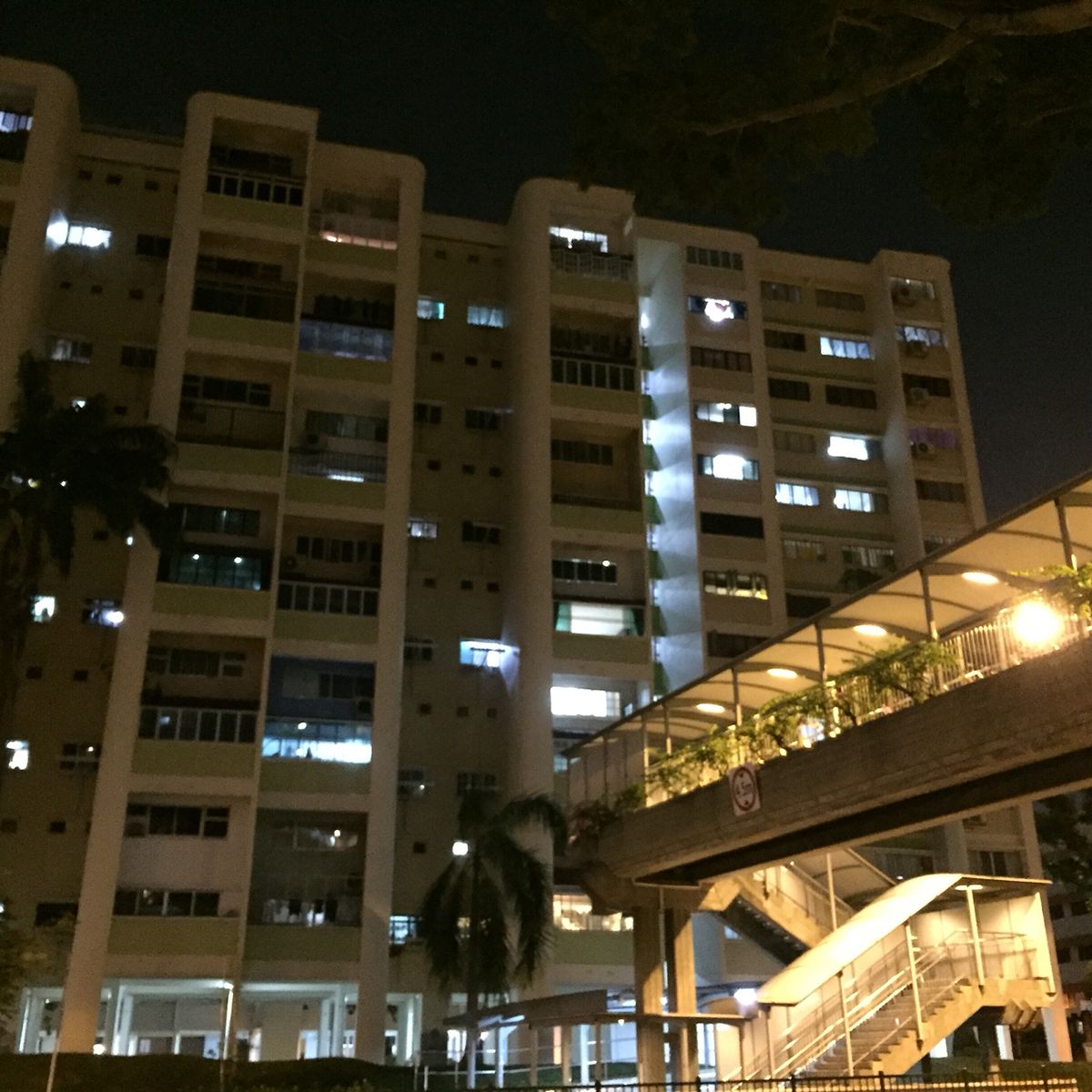
By the time I reached my apartment complex, only a few of the windows were dark and bottomless, with most glowing dark orange and yellow above the bright white lights of the void deck. Red lanterns hung from doorways, lit, and their red lights grew stronger and stronger with every step I took closer to the complex, like anti-aircraft lights flashing alone in a still night sky.
The smell of burnt offerings reached me before their voices did, the soft twinge of charred paper and ink, along with the sweet waft of joss sticks and incense. There was a barrel right at the edge of the void deck, dark red and metal, blazing with the fire as people poured their gifts to the ghosts in, one after the other after the other. Ash blew up into the air now and again like a strange kind of snowfall, with people hastily shaking their heads and clothes free from where it landed on them.
Did he have offerings sent to him? Could anyone still remember him at this point? Did anyone?
Some aunties were chatting in low, hushed tones by the elevator, but dropped into silence as I came around the corner. Pressing the button to summon it, I stood facing the silver doors, my reflection smudged, my features round, undefined blobs.
They remained silent until the doors began to close. As they came within inches of each other, their voices started back up again. The back windows of the elevator were made of heavy plastic and were clouded with age, dented, and scratched. In it, my eye sockets loomed, dark and hollow, the rest of my face appearing like land surrounding two deep lakes. The elevator rose, and through the clouded plastic, I could watch Chinatown suddenly drop away beneath me, like I was flying through the air.
The elevator came to a stop, and the doors parted with a chime. I was at the level of my apartment. There was nobody in there anxiously awake to see where I was, and the lights would be turned off. There was nothing else for me to do.
As I left the elevator and glided down the corridor to my apartment, as though coming from a memory, I could hear the first notes of an electric guitar as someone began to sing.
Discover more from SeaGlass Literary
Subscribe to get the latest posts sent to your email.
