
Written by Kasturika De
T.W.: Drug Use (marijuana)
It’s 6:14 AM and I am still in bed”, I got up cursing myself. A chapter still remained. It’s my Political Science external exam. I hurried to the exam hall. The exam started at 11, and by 1 pm, I was out in the sun, struggling with my umbrella. Raja Nabakrishna Street looked at me with its strange, unknown demeanor as I covered my nose from the thick urine stench coming from its public toilet. It had now become a subconscious behaviour from a conscious practice.
In a rather familiar place, even the unknown impersonates the known. But what if your conscience is forced to replace and reprogram this whole system of familiarity? Will that not be difficult for most of you or will it be even easier?
My olfactory system rejected all except the smell of food. I had to visit Rupali Mishtanno Bhandar, a famous shop near my hostel that served Indian sweets, dosa, veg thali and all other vegetarian dishes. But it was still 7 minutes away, and by now, my body, tortured by the sun, desperately entered a small hotel that serves Bengali thali.
I washed my ink-stained fingers by the time till they brought the rice, dal and crispy fried potato. Famished, I would have hurled myself upon the cold food if not for Ravina’s call. Her voice sounded like that of a little child lost in a fair—unaware and tense—in a low voice she asked, “Where are you, Di?” (Di – used commonly for elder sister in India).
I told her my location, concerned. Then, I asked her what had happened, and in answer, I hadn’t in the least expected this.
“Di, Olivia ka breakup ho gaya kal raat.” (“Olivia broke up last night.”)
I didn’t know how to react. She had left our hostel just a month back, and I knew her better than anyone in our hostel. Room 400 had three beds occupied by four people half of the time. She barely entered her room when her roommate was around. I hardly gave credence to the theory of a ‘mirror world’ until I came across her caffeine intake habits. Coffee had to activate her sleep cells every day after dinner for a peaceful nap. But this was not all that there was! Her typical Christian attitude of praying before the first bite made me question her religion. Subsequently, the answer to this made me question my upbringing. A Hindu born, praying before her first bite is a rare sight. In particular, a Bengali girl like me can never make it a habit. The sweetest of all was that hug she gave us anytime she was extremely happy or sad. Her belongings that remained scattered everywhere in our room had left us with sweet memories of her stay. We used to smoke together, got drunk together, and danced and sang and even sleeplessly studied together before the exam. These months together passed by like years.
Without any progression of thoughts, I asked Ravina, my roommate, to bathe and get ready until I had reached.
Then, Ravina and I boarded an auto-rickshaw that almost flew us to her destination. She came running and hugged the both of us tightly, almost wanting to fit us in her small arms—me in one and Ravina in the other; they saw triplets dancing on their way home to reunion.
Yes, home—because they might have assumed the space to be filled with years, but to their assumption and our awareness, it was countless days wrapped in a countable month. As we entered, I witnessed a heavenly abode for insects—a huge garbage bag filled up to the brim that was centrally placed in a passage common to two bedrooms, ending in one kitchen beside a bathroom. “A home!” I exclaimed within. I entered her room, scattered as expected. We sat on a mattress laid out on the floor. She was happy to see us having brought her favourite dark chocolate without nuts.
The space a month made had depleted that connection between us. The elder sister in me was enraged on hearing her problems from a third person. On our way to her flat, all she said was, “He is no more interested in me. That’s all he said to me and how he lost it”. How can this be possible? Why are women burdened to figure out all of this early? Why can’t we just love like a man—daringly and expect loyalty no matter what. A woman holding tight, her notorious kid crying for a toy never really helps. You need to purchase it anyway and keep cool despite finding it perfect for the bin. Their demand never ends at one. Our loyalty and dedication are constantly proving themselves to a futile race of men.
You don’t challenge winter unless winter makes it challenging. As the story progressed I saw that woman in her struggle with her challenging consciousness of the present and her notorious past, as it left no attempts to make her cry out what’s inside. This battle slowed down when the first long puff from the roll got into her nerves. That day for the first time we witnessed the power of marijuana. I credited myself for smoking ganja and yet not being high enough to laugh or cry out loud. Meanwhile she was all soaked in tears, howling, while I held her palms tightly in mine, making no attempts to stop her.
Consciously, she wanted this, but her awareness of our presence and every subconscious reasoning against wasting tears had sabotaged all earlier trials of her conscience. This was the fine time to let her go, so that she could let go. I focused on the grey matter, not the one inside but the one hanging outside the bright end of the roll, trying to detach itself. With every millimetre of it burning a bright bachelor into ashes, her consciousness tried to reveal the subconscious life she had lived with him every night. I wished to have a whole of that roll meant just for me, since that one travelled among four of us, and was rubbed to death. I had longed for this sort of intoxication that Olivia was enjoying right now. No cry, no laugh—now I felt deceived by my high expectations of its reaction.
Why am I pushing sanity inside?
They are happy—who miss no chance to
live in this utopia.
Where nothing matters what you say, to whom you say;
Every why concludes in
“I was intoxicated”.
All your manners survive no judgement,
but enjoy the luxury of ignorance.
When the Multiverse of Madness kicks in,
Ethics of Brain helplessly lets
the Aesthetics of Heart take over.
She said “He kept his toothbrush here. When I had asked why why was he leaving it here, he had said, “Ab se yeh toh mera bhi ghar hai”. Di, usne toh ise apna ghar maana tha na”. Yes, he had accepted it as his “home”, but does that make any promise? A promise to stay together forever and build one? No, it doesn’t. Rather, it never did. But if there is no love, even building one is like a brick cage that lets nothing in or out. Just you, enclosed within yourself. But what disturbed me even more was her flatmate’s deliberate attempt to stop her from thinking about him in this mode of intoxication, while the very next moment, she dialed him and forced Olivia to talk. They talked in Nepali for 11 minutes as we lay staring at our screens. Finally, when all of us were awake, she regretted talking to him. Her body was still rejecting normality as she walked to the nearest snack shop. All gatherings among Bengalis are incomplete without chop, beguni, singara and other deep fries. Though I was the only Bengali in the room, Bengal lives through its evening deep fried snack culture, in any non-Bengali setting. After snacks and tea, we reached the terrace—the only place bounded by bricks layered with a mix of barren components that lets you enjoy abundance within a safe boundary. We watched the golden building of Kolkata’s ITC hotel and a few others pointing to the sky with all their might.
These familiar sights felt different from there. We kept watching, trying to find a star. Was it her mistake to date a man? Yes, she knew very less but still she considered him her home. Was it normal to feel so in just two months into a relationship for both of them? That day, the person whom she thought she knew, she was familiar with: now holds no relevance, no importance, no name. She failed to recognize, but the question is who—herself or the man—did she consider her home secretly.
Yet another ride, back home, the autorickshaw came out from its stand with flying colours of a dupatta. While reflecting on my own relationship with every passing billboard and house, the dupatta added a feminine touch to everything it brushed on its way. “I have to see for myself, I need to survive. I can’t expect someone else to fulfill my part of work”. These words from the driver floated casually but felt deeply personal. Yes, we are designed to think of ourselves first, or even if someone distinguishes themselves as a selfless person, the society leaves no chance to bring their focus back on self. But how true is it? How selfish are we in reality? Or are our selfish actions a byproduct of self-centered societal expectations?
She made no trials. She wanted none. She was clear about leaving. She chose to leave him without a second thought. There was no point in stretching this relation when he has lost his interest is what she said. Can a woman leave just like this? How can she be this selfish? Is she at all selfish, or is this decision of hers a byproduct of his self-centeredness? If I am down with these doubts, then am I the one who believes in women surviving for the sake of a man. Do we really need them to survive this world? Now that is debatable. Maybe we have the right to think of ourselves and make conscious choices selfishly, but ninety percent of us fear to make our own choices. Her twenties will live free with this choice to leave but this won’t be the same cage as her forties. Now that Olivia has made her decision, she is a million steps ahead of them and closer to enjoying her right to choose.
Can we live alone? Can humans survive happily all alone without a human partner, except a bunch of friends, available only when they need you? The question haunts us all when we realise the loss of a person—talking to whom had become a habit.
How do you get rid of a sweet habit, an obsession just by intoxicating yourself and crying for hours and partying with friends? Her then‐conscious decisions made no sense to me eventually because I know she is suffering inside, even if she denies, her body is holding the pain with care. The man who left was happy initially, but with decaying time he will slowly realise what he lost. He might not admit it but something will burn dormantly.
All of this was possible just because she was familiar and aware of this situation from her past. Subconsciously, she was prepared to tolerate this pain. Aren’t all women machines designed with inexplicable toleration dynamics? That day, more than us, that intoxication became her home. That escape from the so-called home made her realise where her real home is.
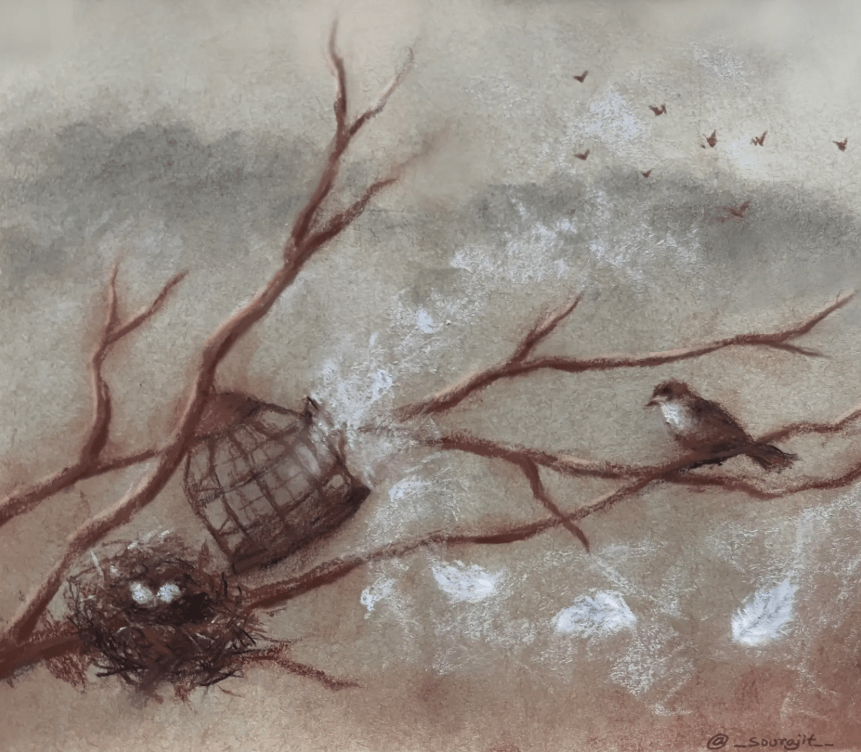
She can’t count thousand sparrows
But she lives like one.
Migration? A fallacy, she says
Even if the destination is far.
Discover more from SeaGlass Literary
Subscribe to get the latest posts sent to your email.
