
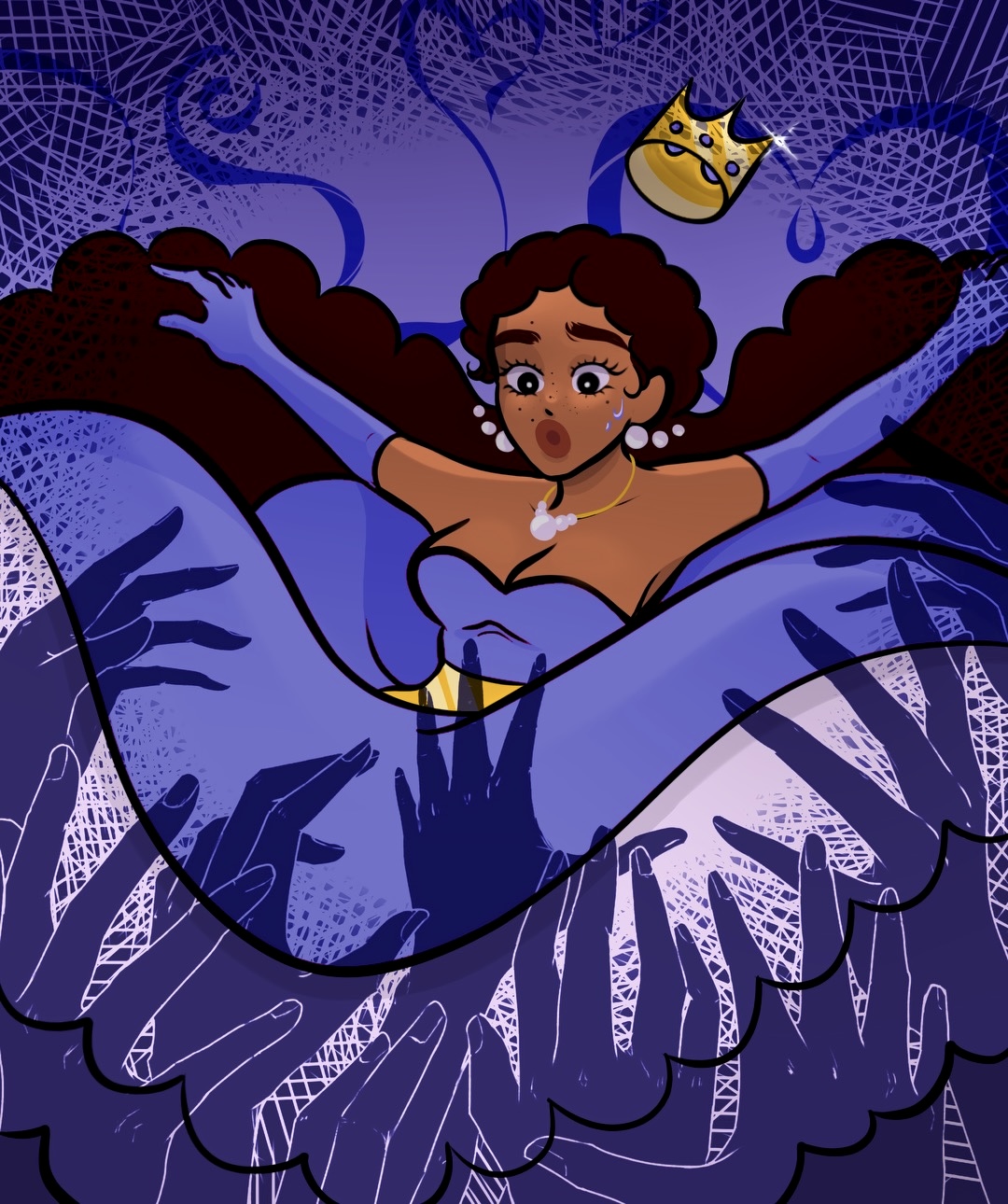
Research Paper by Fadun Adenuga
The real issue with Disney’s colour-blind casting, the perpetuation of hate against non-white women in media, and the consequence of ‘forced’ representation.
With the release and lackluster reception of Disney’s Snow White (2025), directed by Marc Webb, the public has been left wondering: who is to blame for this box office failure? Some critics have highlighted the “blandly artificial” sets (Katie Walsh, The Spokesman), “super-creepy” CGI dwarves (Nadira Goffe, Slate), and even Gal Gadot’s unimpressive performance. That being said, the movie’s lead actress, Rachel Zegler, has arguably received the most aggressive and negative reaction from internet users, starting from the very announcement of her casting.
Zegler’s role as Snow White is just the latest in Disney’s increasing line of race-swapped characters, following the likes of Halle Bailey as Ariel in The Little Mermaid (2023) and Yara Shahidi as Tinkerbell in Peter Pan & Wendy (2023). This calls into question the intentions of Disney executives, especially with the consistent vitriol directed at these actresses whenever these “creative decisions” are announced.
Backstage.com describes colour-blind casting as a practice that “involves casting directors putting together ensembles without taking an actor’s race or ethnicity into account”. On paper, this sounds like a wonderful idea. It feeds into the general belief in a meritocratic society that rewards those with the skills, regardless of race. However, this works better as a concept than as a practical solution to decades of racism and white supremacy in the film and TV industries. Micha Frazer-Carroll, writing for The Guardian, points out some shortcomings of colour-blind casting. These included criticisms that the practice often “compromises historical accuracy” and may “remove key messages from stories”.
Despite both Bailey and Zegler being put in the same uncomfortable position of playing originally white roles, the public’s reaction to the former differed greatly from that of the latter. While Bailey did receive a significant amount of racially charged criticism, including the trending hashtag #NotMyAriel, she was also showered praise for her performance in the movie and her gracious attitude towards the role. Descriptors such as “humble” and “classy” were used for her response to the racism she experienced. As a result, she was widely supported by audiences and professionals alike, including Rob Marshall, the film’s director, and Jodi Benson, the original voice of Ariel in the 1989 film.
This greatly differs from Zegler’s experience which was far more catastrophic, especially following interviews, which led to her being labeled “ungrateful” and a “brat” despite her clear appreciation for the role. The night and day reactions to these two actresses reflect the common phenomenon where women, particularly women of colour, are tone policed, criticised for their tone or manner, and expected to behave cordially and respectfully even in the face of demeaning and distressing situations. Disney’s intentions seem especially nefarious due to the lack of support Zegler received during this harrowing period of being subject to intense online hate speech and bigotry.
Hate speech has become synonymous with existing online, with a third of internet users experiencing it (U.S. Government Accountability Office) and platforms such as X (formerly Twitter) becoming cesspools that breed bigotry. Ed Saperia says this is because “controversial” and “extreme content drives engagement” (The Guardian). This, alongside the “pervasive” “proliferation of false content” (Jesus Serrano, World Economic Forum), has made the internet a very dangerous place to be, especially for women of colour. In March, Emmy-award-winning actress Ayo Edeberi claimed via Instagram stories that she had received “insane death threats and racial slurs”. This followed false reports of her starring in a Pirates of The Caribbean remake she had “never even heard of”, which Elon Musk shared with the caption: “Disney Sucks.”
There are many links between experiencing racism and a range of physical and mental health issues, such as depression and anxiety (Medical News Today). This is why the mental wellbeing of actors and actresses doing their jobs should be prioritized, from the moment casting decisions are made. With this in mind, Disney’s insistence to put women of colour in the crossfires of racist critique is disquieting, especially given the state of their live-action remakes. The company’s disinterest in creating new stories is clear, with a whopping ten out of the twelve releases for 2025 being sequels or remakes. Disney’s live-action adaptations of classics, from The Lion King to Lilo & Stitch, have been criticised for lacking originality and being “nostalgia bait.” Knowing this, it is clear that Disney is uninterested in innovation in its storytelling. So why does the company continue to cast non-white actresses in white legacy roles?
Colour-conscious casting is considered a more progressive and holistic alternative to colour-blind casting, as it “actively acknowledges and considers race” instead of “attempting to ignore it” (Micha Frazer-Carrol, The Guardian). This approach justifies its “non-traditional” casting choices by making them a part of the story. The final product then feels more authentic, rather than a by-product of some executives’ aim to check off every diversity box. It becomes apparent that The Walt Disney Company’s decision to race swap characters is not grounded in authentic representation, but rather an attempt to appear more progressive and inclusive, at the expense of the well-being of the women they cast.
Bibliography:
https://www.spokesman.com/stories/2025/mar/19/film-review-snow-white-will-resonate-with-kids -not/
https://slate.com/culture/2025/03/snow-white-2025-movie-disney-box-office-reviews-rachel-zegl er-gal-gadot-controversy.html
https://www.backstage.com/magazine/article/color-blind-casting-76238/
https://www.gao.gov/blog/online-extremism-growing-problem-whats-being-done-about-it
https://www.medicalnewstoday.com/articles/effects-of-racism#adults
Discover more from SeaGlass Literary
Subscribe to get the latest posts sent to your email.
